
Identity & Resilience Study · The Atkinson Institute
Rank, Relocation,
and Resilience.
Understanding military spouse identity across all branches and stations.
Military spouses hold families together through constant relocations, deployments, and upheaval — while navigating career gaps, rank culture, and the quiet work of rebuilding community from scratch. This study puts data behind what you already know firsthand.
Your response directly informs published research
on impostorism, belonging, and identity.

"The military spouse does not arrive at impostorism through personal failure. She arrives there through the systematic dismantling of every structure through which competence is normally recognized."
Your experience is a data point the field is missing.
Military spouse identity has been underrepresented in impostor phenomenon research. What exists focuses on individual psychology — not on the structural conditions that generate self-doubt in people who move every two to three years, rebuild careers from zero, and manage households through deployment cycles.
This study exists to change that. Your responses will directly shape publications, policy recommendations, and workshops designed for your community — not adapted from research that was never about you.
Relocation and the career gap problem
Licensing that doesn't transfer. Resume gaps that require explanation. Constant restarts in new markets. We're measuring how these structural conditions affect professional self-worth.
How rank shapes community belonging
Whether rank affects how spouses are treated, what opportunities feel accessible, and whether community participation feels available — or conditional.
Identity outside the uniform
Whether spouses maintain a clear sense of self outside their partner's career — and what factors support or erode that clarity across duty stations and deployments.
The specific weight of international moves
Visa restrictions, SOFA agreements, healthcare access, and distance from extended family create conditions that compound impostorism in ways CONUS research misses entirely.
Four areas of inquiry
The survey is organized into four sections, each addressing a distinct dimension of military spouse identity. Together they produce a complete picture of how structural conditions interact with personal self-perception.
Who You Are
Branch, rank, status, location, years of service, and employment — the structural context that shapes everything else. This section establishes patterns across populations.
How You See Yourself
Adapted from validated impostor phenomenon instruments, this section measures self-doubt, attribution patterns, confidence, and identity clarity across relocation cycles.
Where You Fit In
How rank affects belonging, participation, and treatment within military spouse communities. This section tests the Structurally Induced Impostorism framework against lived experience.
Where You Stand
Employment status, barriers to work, remote access, burnout, anxiety, and hope — capturing the gap between where spouses are and where they want to be.
Who should take this survey
10–15 minutes · Anonymous · No purchase required · Withdraw anytime
This survey tests an original framework
This study is not a standalone questionnaire. It is the empirical test of a framework introduced in The Atkinson Institute's peer-informed publication series. Your responses will confirm, challenge, or refine the argument that impostorism in military spouses is structurally generated — not personally produced.
"When environments repeatedly disrupt the infrastructure of identity, impostorism becomes a structural outcome — not a personal one."
Atkinson, 2025 · Structurally Induced ImpostorismA form of the impostor experience generated not by personal psychology but by repeated, institutionally imposed disruption of the social and professional structures through which identity and competence are normally constructed. Military spouses face this as a systemic feature of their institutional context — not as individual pathology.
Three environmental triggers from the Atkinson Institute framework — adapted here for the military spouse context and measured across rank, relocation frequency, and duty station.
The scope of the problem
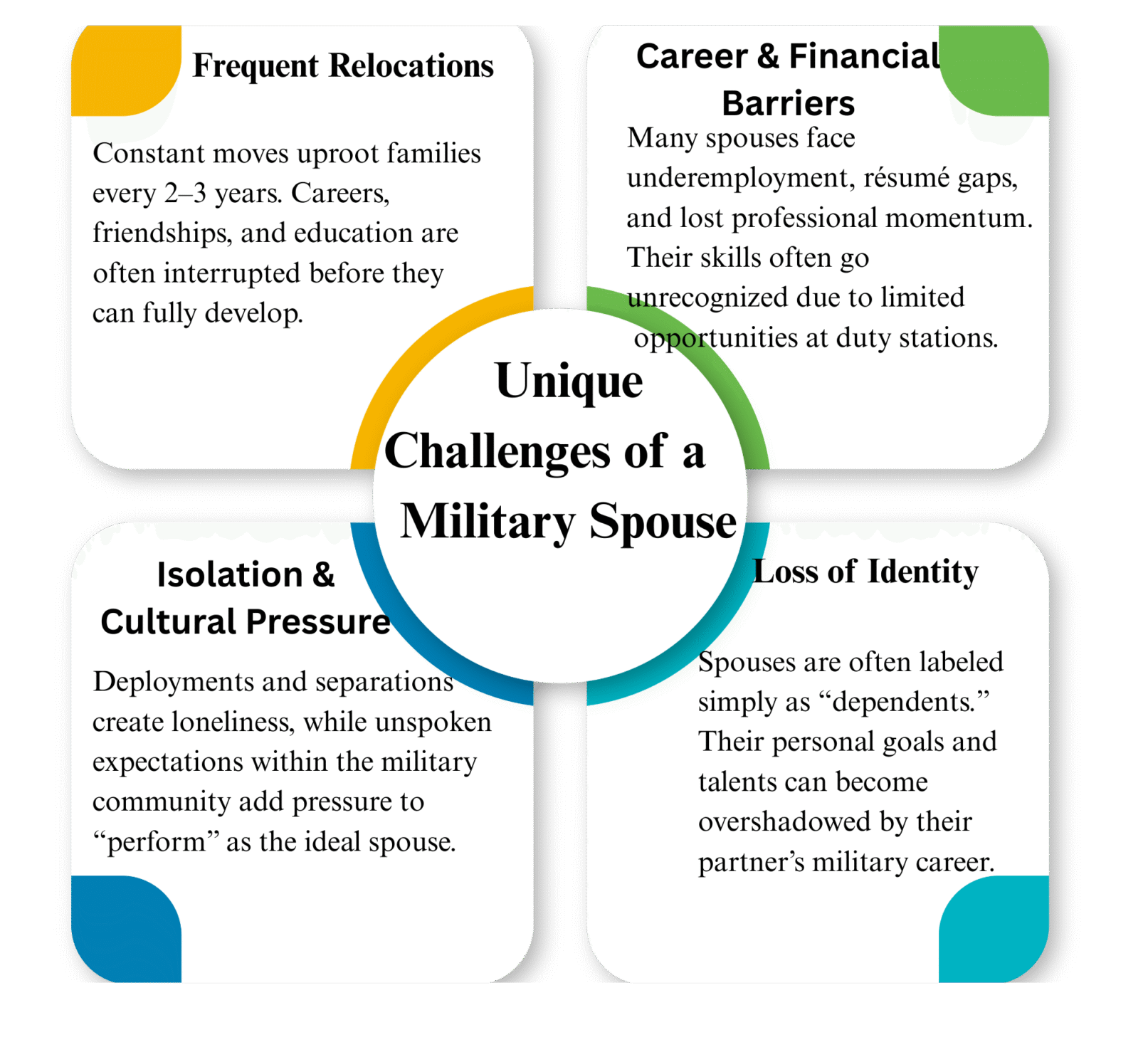
This infographic captures the major themes of struggle and resilience shared by military spouses across careers, housing, and family life. Your survey responses add real data to this picture.
Before you begin
Your story
becomes the data.
Ten to fifteen minutes. Fully anonymous. No purchase required. Your experience becomes part of a body of research designed to advocate for military spouses — in publications, in policy conversations, and in workshops that reach communities like yours.